
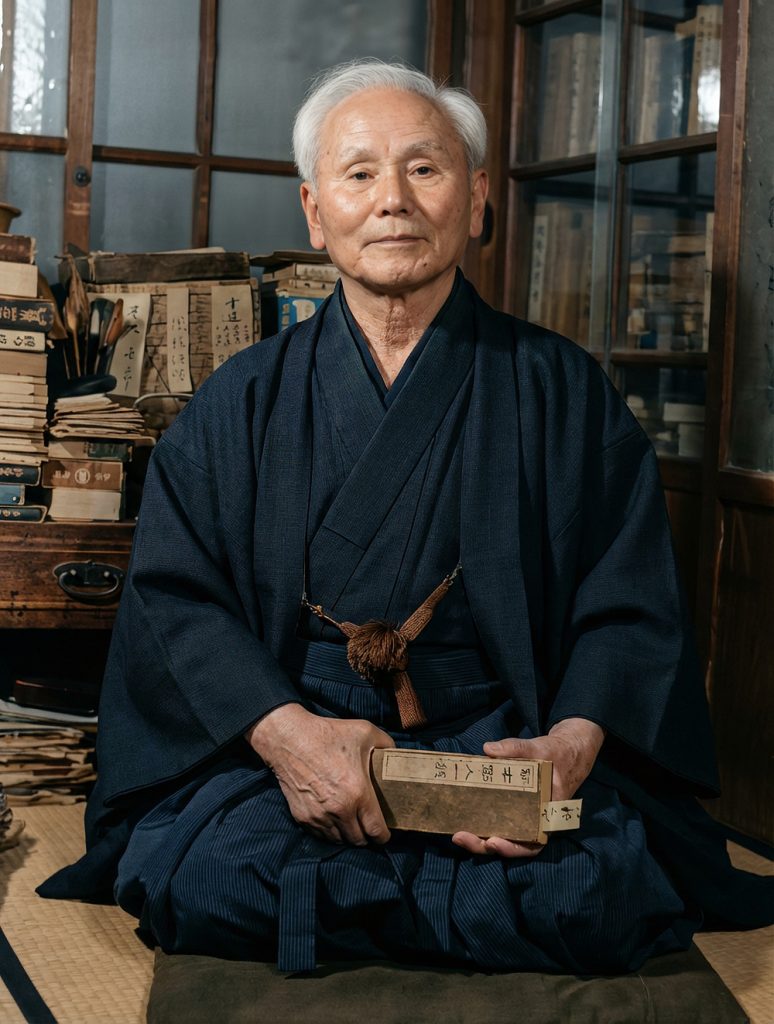
Gichin Funakoshi (1868-1957)
Gichin Funakoshi also published details of 40 vital point locations in charts included in his 1935 edition of ‘Karate-do Kyohan’ under a section titled ‘Jintai Kyusho’ (Human Body Vital Points) which were based on densho scrolls from Shindo Yoshin Ryu jujutsu presented to him in Japan by Hirinori Otsuka.
Distinctions are often drawn between the accupoint charts in the Bubishi and Mabuni’s ‘Sepai no Kenkyu’ and the modern western medical charts published by Funakoshi in ‘Karate-do Kyohan’ but it should be remembered that after the Meiji Restoration (1868-1869) Japan abandoned its interpretation of TCM in favour of the importation of the contemporary western medicine, passing into legislation the implementation of the German Medical System in 1874.
It was Hironori Otsuka who presented Gichin Funakoshi with the vital points chart in ‘Karate do Kyohan’. This chart appears to be the same chart utilised in the Shindo Yoshinryu jujutsu tradition, and was a gift to Funakoshi from Otsuka in commemoration of the publication of ‘Karate Do Kyohan’.
Otsuka also acted as ‘Uke’ for Funakoshi demonstrating ‘nage waza’ (throwing techniques) & ‘Idori’ (kneeling techniques) in ‘Karate do Kyohan’.
Otsuka was Funakoshi’s assistant instructor, traveling with Funakoshi throughout Japan giving demonstrations in karate.
In ‘Karate Do Kyohan’, Funakoshi makes reference to the Bubishi and also mentions both the ‘Shichen’ theory (Diurnal Cycle) and ‘Moxa Cautery’, the Chinese science of applying heated needles to acupuncture sites, both of which are based on TCM, acupoints & meridians, so it’s clear Funakoshi had a basic understanding of TCM.