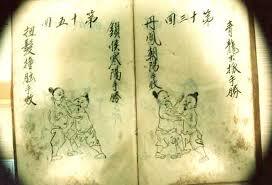
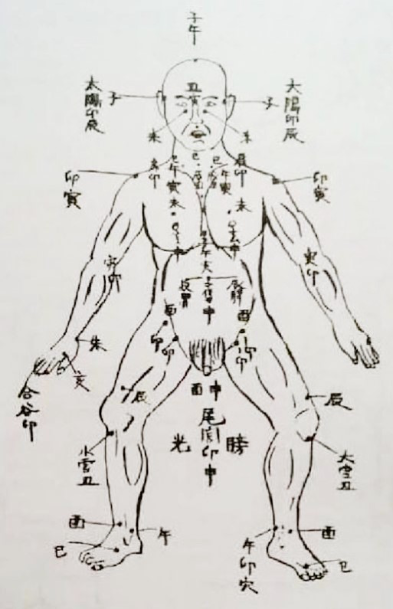
In terms of the written history of karate, perhaps the oldest martial reference we have is the ‘Bubishi’, a text of unknown origin, that was owned by prominent 19th century Okinawan karate masters. Written in the Fujian dialect it is a manual which highlights Traditional Chinese Medicine practices, the 36 vital points first identified by the Taoist monk Feng Yiyuan and details relating to the ‘Shichen’ theory (Diurnal Cycle) of TCM amongst other relevant information about the Southern Chinese boxing systems.
Some sources believe that the Bubishi is based on ancient Chinese manuals of combat which depict hundreds of structurally unique locations in the human anatomy. One of these manuals, the ‘Wu Bei Zhi’, is often considered the source of the Bubishi.
It’s commonly thought that the Bubishi may have originated either from the Ryukyu Kan in Fuzhou or brought into Okinawa by one of the many ‘Sapposhi’ (military advisors or envoys) sent to the Ryukyu islands by the Chinese or some of the prominent toudi masters who were known to study in Fuzhou.
It’s clear that the Bubishi was considered an important source text for some of the 19th century karate masters who were first associated with teaching karate to the general public as handwritten copies were known to be made.
It is thought that oldest handwritten edition of the Bubishi still in existence is a manuscript belonging to Seiko Higa (1898–1966). Seiko Higa was a student of both Kanryo Higashionna & Chojun Miyagi but it is thought his Bubishi manuscript probably came to him from Chojun Miyagi.
A handwritten copy was discovered in Kumemura, Naha, within the Koshio Matsuta building in 1933 by Eisho Nakamoto (1881-1945), a teacher from Fuzhou. It is thought that this copy was transferred to the Okinawan National Library but destroyed in the bombing of Okinawa in 1945.
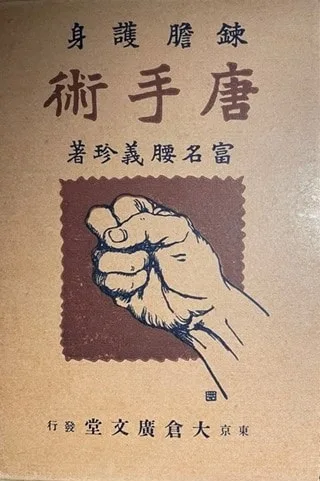
When Gichin Funakoshi published the first book on karate in Japan in ‘Ryukyu Kenpo Toudi’ in 1922, four chapters from the Bubishi were included at the end of the book, but the Bubishi itself was not named. The Bubishi section was also not translated. It was left in its original Chinese style of writing.
In the 1926 reprint of ‘Ryukyu Kenpo Toudi’ published under the title ‘Rentan Goshin Karate Jutsu’ Funakoshi included sections from the Bubishi: ‘Eight Important Phrases of Karate’, ‘Treatise on the Ancient Law of Great Strength’ and ‘Methods of Escape’ and left them in their original Chinese without offering translation.
The same segment from the Bubishi was later published in the English version of ‘Karate-Do- Kyohan’ published in 1973. The translator noted that he was unable to locate the original source of the material reproduced that was written in the Chinese style.
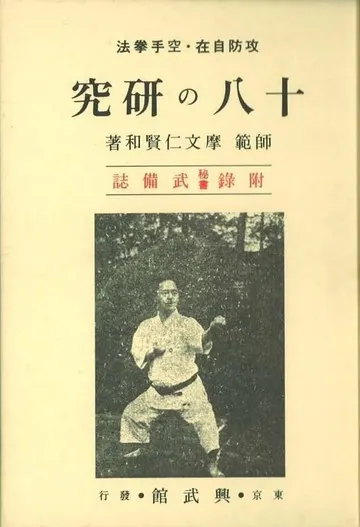
When Kenwa Mabuni published ‘Seipai no Kenkyu’ (Study of Seipai) in 1934, the Bubishi was named. Mabuni included the drawings from five chapters from Anko Itosu’s copy of the Bubishi (Itosu had been Mabuni’s principle teacher).
Interestingly, Mabuni dedicated more pages of his book to the Bubishi (95, in fact) than he used for the purported subject of the book (79 pages), the kata Seipai.
Seipai No Kenkyu includes a number of articles in Chinese including 28 of the 48 self defense techniques from the Bubishi.
‘The Delayed Death Touch’ and ‘Twelve Hour Dragon Breath Time Charts’ are all taken from the Bubishi.
In another later text, ‘Karate, Goju-ryu’ by Gogen Yamaguchi (founder of Japanese Goju karate) published on 1966, excerpts from the Bubishi were included.
The chapter titled, ‘Introduction of Part of Bubishi’ in Yamaguchi’s book contained mostly (35 of the 38 pages) illustrations of self-defense moves and/or diagrams of the body’s vulnerable points from the Bubishi. The English translation of the book had no translations of the written text.
Wu Xian Gui, known in Okinawa as ‘Go Kenki’, the Chinese Tea Merchant who taught White Crane Boxing on Okinawa and was a leading member of the ‘Todi Kenkyukai’ (Karate Research Society) is known to have brought a copy to Okinawa from Fuzhou with some sources suggesting that his copy eventually fell into the hands of Anko Itosu, which he used as the source for his ‘Ten Teachings of Karate’, written in 1908, which expounded the merits of Todi’s teachings for inclusion in the physical education curriculum at the turn of the 20th century.
It’s clear be any standard, that the Bubishi was considered an essential text by some of the most historically significant karate masters of the 19th century.
Of particular interest to the study of Kyusho Jitsu is the 36 vital point chart published in the Bubishi. The chart is based on the meridian charts first produced by Hua Shou (1304-1386) a fourteenth-century Chinese acupuncturist. Hai Shou refined the meridians first depicted on the Tongren Bronze Man created in 1027 AD by Song Dynasty physician Wang Weiyi.
The chart featured in the Bubishi is the same chart depicted by Kenwa Mabuni in Seipai no Kenkyu relates to the 8 extraordinary vessels and 12 main meridian channels of TCM.
The Bubishi also provides description of the ‘6 Ji Hands’; a series of six hand positions designed to strike acupoints and thought to have originated from Southern Chinese boxing systems such as White Crane and Lohan boxing.
Details are also included of the Shichen theory (Diurnal Cycle) of TCM which charts the cycle of ‘Chi ’or ‘Ki’ through the body’s meridian channels.
The significance of the Bubishi as a historical document and its influence on Okinawan martial arts, deserves serious study and research by contemporary martial artists in order to understand some of the influences on the development of karate and on anatomical targeting, that was considered important knowledge by so many significant early karate masters.
‘Do not seek to follow in the footsteps of the wise; seek what they sought’ – Matsuo Basho (1644-1694)