Dim Mak and the Origins of Kyusho Jitsu
Taoist elements of Traditional Chinese Medicine, such as the meridian theory, have a direct connection to the martial practice of skills such as Dim Mak (Dian Xue) & Chin Na (Qinna), considered the source of Kyusho Jitsu and Tuite (‘Grappling’ or ‘Seizing Hand’).
Dim Mak (‘press artery’ or ‘press cavities’), also known as the legendary Death Touch, is a system of attacking the anatomical structures of the human body said to have been developed by Taoist monks.
Dim Mak is a Cantonese term, Dian Xue is a Mandarin term. Dian means to point with a finger or squeeze and Xu means nerve point.
References to Dian Xue appear as early as the 17th century in one the earliest extant manuals of internal martial arts, the ‘Neijia Quanfa’ by Huang Baijia, a practitioner of martial arts from Wudang and direct student of Wang Zhengnan (1616–1669), a renowned practitioner and teacher of Chinese internal martial arts during the early Qing Dynasty, known for his connection to the Wudang style of boxing.
It’s speculated that legendary Taoist immortal, Zhang Sanfeng, initiated the introduction of Dian Xue techniques into the internal arts, especially Tai Chi, which was later expanded upon by other monks such Feng Yiquan; a Chinese Shaolin martial artist active during the Ming Dynasty (approx. 1522–1567) who first referenced 36 vulnerable points of the human body.
These 36 points are often categorised into four groups of nine, based on the effect of the strike: 9 causing pain, 9 causing paralysis, 9 causing unconsciousness and 9 causing death.
Feng Yiquan later combined anatomical knowledge with Traditional Chinese Medicine (TCM), targeting the 12 meridians and 8 extraordinary vessels, and introduced the concept of Shichen (Time Periods); the timing of when specific meridian channels are more vulnerable during the day.
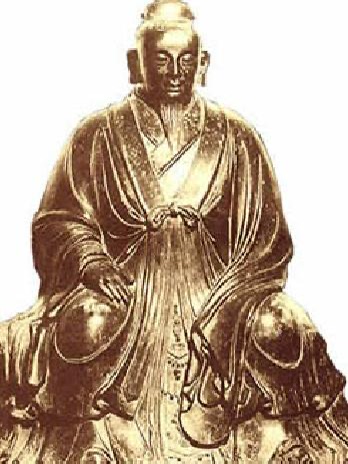
This 36 vital point theory is the basis of the 36 vital points featured in the Bubishi and often associated as the origin for the development of Okinawan karate kata such as Sanseru (36 Hands), thought by some to represent the striking of these 36 vital points.
These 36 vital points developed into a more complex system targeting 72 or 108 points that may be connected to the kata Suparinpei (108 Hands) thought to reference the combination of available striking points and Buddhist religious numerology. This is speculation of course, but it’s an interesting footnote that 108 divided by 3 equals 36 and the divisor 3 is represented by by Sanchin (3 Battles) kata, considered the foundation kata of both Sanseru & Suparinpei.
While this could be put down to simple numerical coincidence, the study of these kata, together with the knowledge of the meridian system of the body and the 36 vital points listed in the Bubishi, is an interesting exercise to say the least and these 36 points are regularly referenced across Chinese martial arts in similar formats.
Ancient texts on Dian Xue pressure points, including Shaolin Monastery’s training manuals, offered a vast array of herbal remedies for the treatment of strikes to acupoints. These texts not only teach the signs and symptoms of injury to pressure points, but they also teach how pressure points work on the human body
This too, correlates with the Bubishi which contains a significant section dedicated to traditional Chinese herbal medicine, particularly focusing on healing injuries sustained from training or combat.
The Bubishi outlines various remedies designed to improve circulation, treat weapon wounds, address injuries related to the 12-hour Shichen cycle of energy flow including details of twelve-hour herbal prescriptions & twelve hour green herbal remedies. These treatments improve blood circulation for treating injuries that are more severe during the meridian flow at different times of the day and treatments relating to the 36 vital points described within its text.
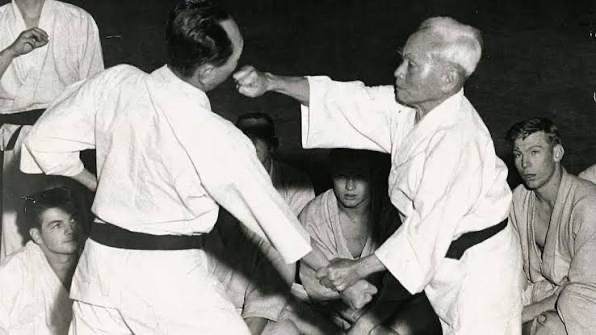
Qinna (‘seize and control’) is a system of joint locking, pressure point pressing and striking techniques based on attacking the meridian channels of the body, the objective being to control and lock the opponent’s joints, skeletal system or muscles/tendons neutralising the opponents fighting ability.
Qinna is based on 7 main areas of attack:
- Fen Jin – (Dividing the Muscle/Tendon)
- Cuo Gu – (Misplacing the Bone)
- Bi Qi – (Sealing the Breath)
- Duan Mai – (Sealing the Vein)
- Zhua Jin – (Grabbing the Muscle/Tendon)
- Dian Xue – (Cavity Press)
- Dian Mai – (Meridian Press)
The roots of Qinna can be traced back to ancient China. Techniques mentioned in early texts such as the ‘Yellow Emperor’s Internal Classic’ and the ‘Classic of Boxing’ written during the Warring States period (475–221 BCE), are thought to have developed by Buddhist monks at the famous Shaolin Temple during the Ming Dynasty (14th to 17th centuries).
Based on Taoist Meridian theories, Qinna was thought to have developed with the introduction of the five animals forms into Shaolin boxing methods and influenced by many of the hand techniques, such as eagle & tiger claw, used for gripping, pressing and ripping.
These techniques led to the development of the 72 Qinna techniques of Shaolin boxing. They were favoured by Buddhist monks because they allowed practitioners to subdue an attacker without killing or causing serious permanent injury.
There are an estimated 300 Qinna techniques found across Chinese martial arts today and they form part of Martial Arts systems such as Fujian White Crane Boxing (Baihequan) which were thought to influence the ‘China Hand’ techniques of early Ryukyu martial arts, leading to the development of Okinawan Tuite.
According to noted martial arts writer and historian Patrick McCarthy, Huang Baijia, and his father, heir to the arts of Wudang, transmitted their knowledge of Dian Xue to the legendary Southern Shaolin Monastery. From there, this knowledge would have spread in the Southern Chinese Martial Arts and from there into the Ryukyu Islands.
It takes time to develop the correct level of power, understand the correct angle of attack and develop the effective degree of penetration to compress a nerve between muscles, bones and tendons. Just knowing the location of the vital points and the angle and method of attack are in themselves ineffective.
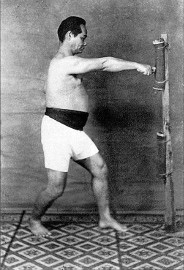
Training in both Dim Mak and Qinna involve many types of hand strikes developed for maximum penetration and damage to the vital points of the human body. Often named after animals, these hand strikes can be seen in almost any karate manual and include techniques such as Ippon Ken (one knuckle strike), Nakadaka Ken (middle knuckle strike), Hiraken (Leopard Fist), Ryutoken (Dragon Head Fist) and others, yet these techniques seldom occur in kata.
The Bubishi too features many specialist hand striking techniques. Hitosashi Ippon Ken (Phoenix Eye Fist) & Tora No Te (Tiger Claw Hand) are obvious examples which are pictured together with more common techniques which have survived in modern kata such as Tetsui (Iron Hammer), Nukite (Spear Hand) & Shuto (Knife Hand).
Unique to the Bubishi is a set of 6 hand positions called the 6 Ji Hands or 6 Energy Hands thought to be techniques referenced from Dim Mak. The targets included in the Bubishi are referred to as Blood Gates or areas that access important blood vessels and/or blood-filled organs and are illustrated along with the Shichen in which the meridian system is most active.
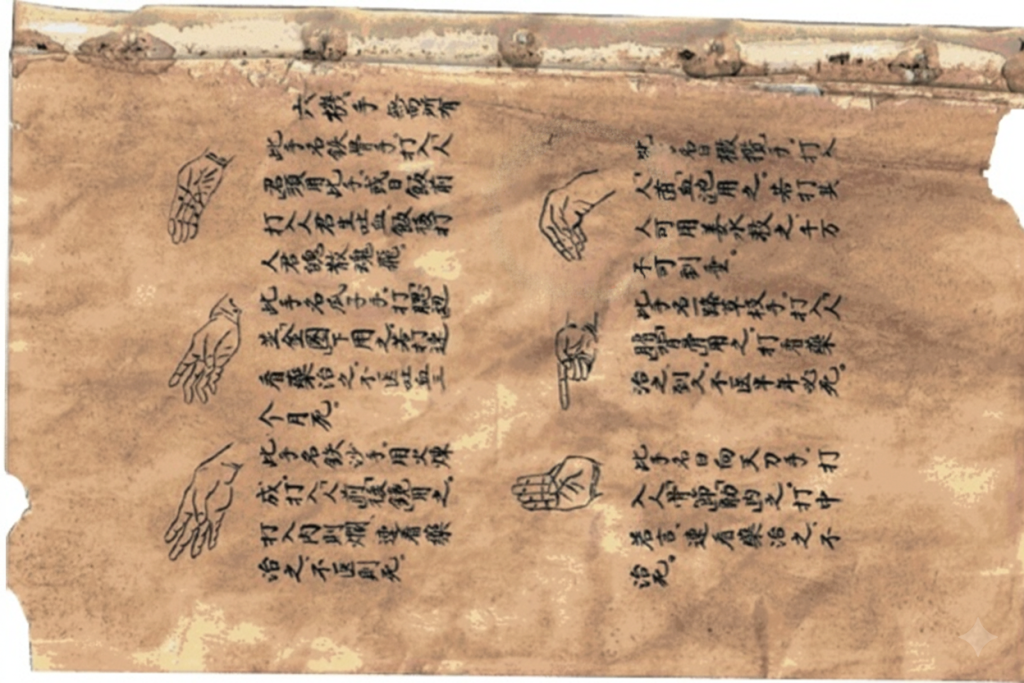
The ‘Ji’ in 6 Ji hands relates to energy transference, often conceptualised as Chi (Qi) or Ki, but rather than some form of metaphysical energy, Kyusho Jitsu Kenkyukai simply interpret as an understanding of physics, of kinetic and ballistic energy and the mechanism of hydrostatic shock.
These techniques would appear to be the ‘dangerous’ techniques Anko Itosu removed from karate when he first began teaching karate in an afterhours class to pupils of the Shuri Jinjo Shogakko (Shuri Elementary School) in 1901.
Dim Mak and Qinna are generally accepted as being more involved than Kyusho and Tuite. Like their Okinawan counterparts, they are not considered seperate arts but an integrated part of traditional Chinese boxing systems, although some instructors teach them separately. As such it’s difficult to find teachers willing to teach them outside the general study of their martial systems. Where we can find teachers of these arts, Kyusho Jitsu Kenkyukai are happy to work with them.