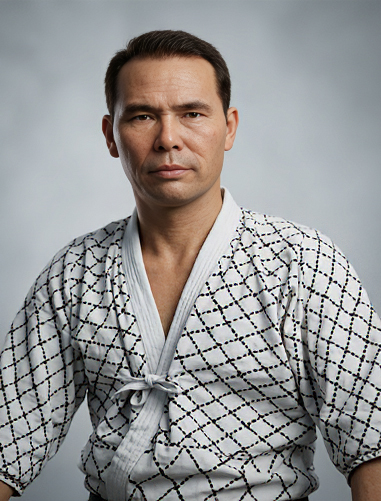
Taika Seiyu Oyata (1928-2012)
Taika Seiyu Oyata is probably more responsible for the popularity of Kyusho Jitsu today than any over practitioner. Although, somewhat eclipsed by Dillman’s shear showmanship and forceful personality, Oyata was considered a true master of Kyusho Jitsu and demonstrated the art frequently after emigrating to the U.S. in the late 1970’s and likely the main source of Dillman’s Kyusho Jitsu.
Oyata learned the art of Kyusho Jitsu from Wakinaguri no Tan Mei, a 6th generation Okinawan whose family migrated to Okinawa from China. Wakinaguri was considered an expert in vital point striking. Oyata also trained with many other karate masters on Okinawa including Seikichi Uehara, inheritor of Motobu Udundi, or ‘Motobu Palace Hand’ system of tuidi and thought to be an original 13 generation old Ryukuan art consisting of traditional Ryukyuan dance, striking, throwing, grappling and multiple weapons including bladed weapons of both Chinese and Japanese origin.
As such it’s widely believed that Motobu Udundi was influenced by Chinese martial arts. Like the old tuidi taught by Hohan Soken, the descriptive terminology of Motobu Undundi is pronounced in native the Okinawan language Uchinaguchi, rather than the more common Japanese pronunciation familiar in modern karate systems.
The term ‘tuite’ is a hybrid word composed of half Uchinaguchi, half Japanese language. ‘Tui’ is to grab or seize in Uchinaguchi and ‘Te’ is the Japanese word for hand. According to Oyata’s students’, the term was coined by Oyata himself in the 1950’s, apparently to avoid confusion by the pronunciation of the Uchinagushi word Toudi.
It should also be noted that Tuite is considered different from Kansetsu Waza, (Joint locking techniques) often practiced in mainstream karate systems but referred to incorrectly as Tuite Waza or Tuite Jitsu, which is uniquely Okinawan.