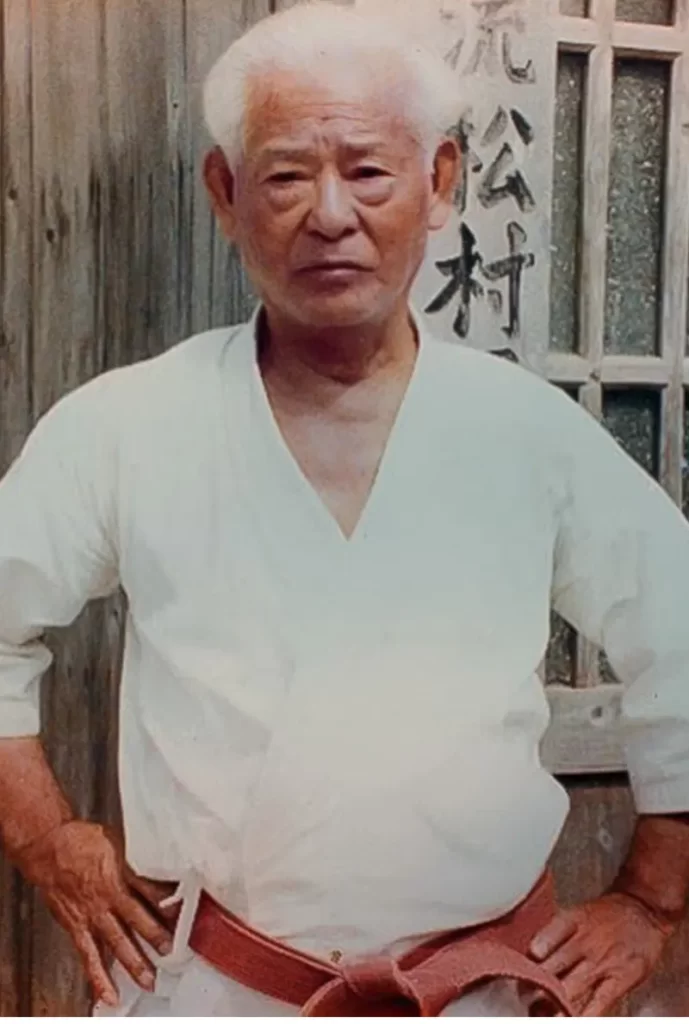
Soken Hohan (1889-1992)
Hokan Soken’s ‘Secret Notes’ are attributed with the re-introduction of Kyusho back into mainstream Karate. These notes were given out to U.S. students at the Kadena Airforce Base by Soken’s student and Chief Instructor Fusei Kise, who taught at the base. The notes were apparently translated into English by Kise from Pressure Point charts drawn by Soken.
‘Soken’s Secret Notes’ are comprised of two roughly hand drawn human diagrams of vital point locations with their corresponding names for 44 vital points. 20 of which are listed as fatal, with the remaining listed as 19 fainting and 5 paralysing or destructive targets. Along with the descriptions of the fatal or fainting points, there is a western medical explanation as to what is affected and causing the dysfunction, fainting or death. Some sources suggest Soken used a version of the ‘Bronze Man’ statue, referenced in the Bubishi, as the basis for these notes.
Soken is said to have learned these techniques from ‘Machimura Suidi’ (also called tuidi, tuite, toude or torite) which was part of the old ‘China Hand system’ of Ryukuan martial arts before its transition into karate. Tuidi (lit. Seizing or Grabbing hand) contained many grabbing/gripping hand techniques, including parrying, entangling, entrapment, grabbing, body and arm control techniques, plus pressure point striking and nerve control techniques. These techniques existed not as a separate art, but simply a subsection of the old China Hand system. Ti & Di or De are Okinawan expressions from Uchinaguchi, the native language of Okinawa, and simply mean hand. The Japanese translation is ‘te’.