
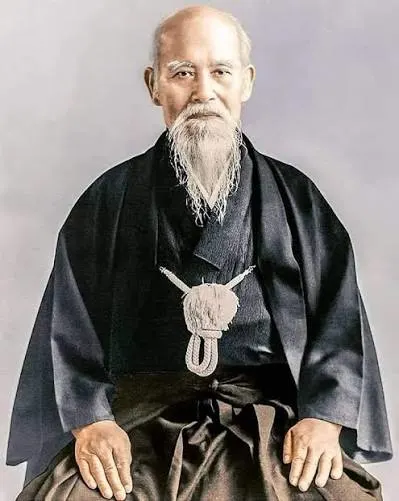
Morehei Ueshiba (1883-1969)
Morehei Ueshiba studied Daito-ryu Aiki-jujutsu under Sokaku Takeda from 1915, receiving a teaching certificate (kyoju dairi) in 1922.
The Daito-ryu system included a vast curriculum of techniques, including specific knowledge of kyusho or atemi vital points for striking, joint manipulation, and nerve attacks. Specific, detailed lists of the vital points themselves are typically found within the technical scrolls (‘eimeiroku’ and ‘hiden okugi no koto’) of Daito-ryu, which Ueshiba received.
Documentary film footage, amongst other sources of historical references, illustrating Ueshiba’s pre-war teaching (before the mid-1930s) show a clear emphasis of these striking points. Techniques from this era often incorporated atemi to disrupt an opponent’s balance and create an opening for a throw or pin.
The use of atemi is a fundamental principle derived from Daito-ryu that is used in Aikido to create a momentary weakness in the attacker’s balance before applying a technique. Modern Aikido styles that preserve Ueshiba’s early methods, such as Yoshinkan Aikido and the Iwama style of Morihiro Saito, still heavily incorporate these strikes.